 By Olivia Wilson
Obtaining a concealed weapon license in Florida requires applicants to meet specific legal eligibility standards, demonstrate firearm competency, and complete the application process established by state law. Although Florida introduced permitless concealed carry for eligible individuals in 2023, obtaining a license can still be useful, particularly for people who travel to states that recognize Florida permits.
The Florida Department of Agriculture and Consumer Services (FDACS) administers the state’s concealed weapon or firearm licensing program under Section 790.06 of the Florida Statutes. Understanding the eligibility requirements, documentation, fees, and restrictions can help applicants avoid mistakes and determine whether applying for a license is appropriate.
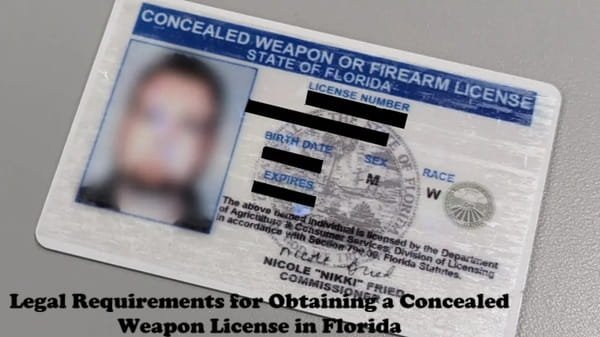
Understanding Florida’s Concealed Weapon License
A Florida concealed weapon or firearm license authorizes eligible individuals to carry specified weapons concealed, subject to applicable state and federal laws. The statutory definition includes handguns, certain electric weapons, tear gas guns, knives, and billies. A license does not authorize every type of weapon or permit carrying a weapon in every location.
Florida generally allows eligible people to carry a concealed firearm without obtaining a state license. However, permitless carry does not eliminate restrictions concerning prohibited locations, unlawful possession, age, criminal history, or other legal limitations. A license may also provide benefits when traveling to jurisdictions that recognize Florida permits, although reciprocity rules vary by state.
Eligibility Requirements for Applicants
Applicants must satisfy the legal conditions established under Florida law. These requirements concern age, residency, firearm competency, criminal history, and other factors affecting eligibility.
Age and Residency Requirements
Florida’s statute generally specifies a minimum age of 21 for applicants, with exceptions for qualifying active-duty servicemembers and honorably discharged veterans beginning at age 18. However, a significant legal development occurred in June 2026: the Florida Department of Agriculture and Consumer Services announced that, following a state appellate court ruling, it would issue licenses to eligible applicants aged 18 and older. Applicants should check the department’s current guidance before applying because legal developments can affect eligibility rules.
Applicants generally must reside in the United States and be U.S. citizens or lawful permanent residents, subject to statutory exceptions for certain qualifying individuals. Applicants who were born outside the United States or hold permanent resident status may need to provide additional documentation confirming their immigration or citizenship status.
Criminal History and Other Disqualifications
A criminal record does not automatically resolve every licensing question in the same way, but certain convictions and legal circumstances can prevent approval. For example, felony convictions may disqualify an applicant unless the relevant firearm rights have been restored as permitted by law.
Other potential disqualifying circumstances include qualifying convictions involving controlled substances, recent misdemeanor crimes of violence, certain court findings or commitments involving mental health, active domestic violence or repeat-violence injunctions, and being a fugitive from justice. Alcohol or controlled-substance abuse can also affect eligibility under specified circumstances.
The rules are detailed, and some circumstances depend on the type of offense, when it occurred, and the legal outcome. Applicants with prior arrests, charges, convictions, or court orders should review the official eligibility guidance rather than assuming they automatically qualify or are permanently barred.
Firearm Competency Requirements
Applicants must demonstrate competency with a firearm through an accepted form of documentation. Depending on the circumstances, acceptable evidence may include a qualifying firearms safety or training course, instruction from an authorized instructor, or other documentation recognized by Florida law.
Applicants should verify that their specific training record satisfies FDACS requirements before submitting an application. Safe handling, storage, and knowledge of applicable firearm laws are important responsibilities, regardless of whether a person holds a license.
How to Apply for a Florida Concealed Weapon License
The application process is managed by FDACS. Applicants can generally apply online, by mail, or in person at an FDACS regional office or an authorized Florida tax collector’s office.
Before beginning, applicants should review the official instructions and prepare the required documents. In-person applications can be convenient because staff can help review the paperwork and collect fingerprints.
Documents and Application Information
Applicants generally need a valid government-issued photo identification, proof of qualifying firearm competency, and the required application fee. Additional documents may be necessary depending on citizenship or residency status, military service, a legal name change, or previous criminal or court proceedings.
The application requires accurate information and is submitted under oath. Providing false answers or fraudulent documents can lead to criminal consequences, so applicants should carefully review all responses before submitting them.
Fingerprints and Background Checks
Fingerprinting is part of the licensing process. Applicants applying in person at participating offices may have their fingerprints collected electronically. Applicants using the mail process must follow the department’s specific fingerprinting instructions.
FDACS reviews the application and conducts the required background investigation. Under the department’s published guidance, it generally has up to 90 days after receiving a complete application to issue the license or deny it. Incomplete paperwork, missing documentation, or additional review requirements can delay processing.
License Fees and Validity Period
Florida’s statutory fee provisions establish a nonrefundable fee of up to $55 for a new statewide license and up to $45 for a renewal, with fingerprint-processing costs and certain service fees potentially applying separately. The amount payable may depend on the application method and office used, so applicants should check the current FDACS fee schedule before applying.
A Florida concealed weapon or firearm license is generally valid for seven years from its date of issuance. License holders must comply with applicable identification requirements and should renew before expiration if they wish to maintain the license.
Where Concealed Weapons Cannot Be Carried
A license does not provide unrestricted permission to carry weapons. Florida law prohibits weapons in certain locations, including specified school-related premises, courthouses, and other restricted areas. Federal law may impose additional restrictions on places such as federal facilities.
Private property owners may also establish rules concerning weapons on their premises, subject to applicable law. License holders should check the restrictions that apply to their destination before carrying a concealed weapon. They must also comply with laws governing the use of force and must not carry or use weapons unlawfully.
Conclusion
Obtaining a concealed weapon license in Florida involves meeting eligibility requirements, providing accepted proof of firearm competency, completing the application, submitting fingerprints, and passing the required background investigation. Although eligible individuals may carry concealed firearms without a license under Florida’s permitless-carry law, licensing can still offer practical benefits. Applicants should consult current FDACS guidance and understand all applicable restrictions before carrying a weapon.
Frequently Asked Questions
Q. Is a concealed weapon license mandatory in Florida?
No. Florida permits eligible individuals to carry concealed firearms without a state license under specified conditions. A license may still offer advantages, including potential reciprocity with other states.
Q. How long does it take to obtain a Florida concealed weapon license?
FDACS generally has up to 90 days after receiving a complete application to issue or deny a license. Processing times can vary depending on the application and any additional review required.
Q. Can a person with a felony conviction obtain a concealed weapon license?
A felony conviction can disqualify an applicant. Eligibility may depend on whether firearm rights have been lawfully restored and whether other restrictions apply. Individual circumstances should be reviewed with a qualified attorney.
Q. How long is a Florida concealed weapon license valid?
A Florida concealed weapon or firearm license is generally valid for seven years from the date of issuance.
Q. Does a Florida license allow concealed carry in every state?
No. Other states have their own concealed-carry laws and reciprocity rules. License holders should verify the requirements of each state they plan to visit.