 By Olivia Wilson
Florida’s Stand Your Ground law is an important part of the state’s self-defense framework. It addresses when a person may use force to defend themselves or others without first having a legal duty to retreat. The law has attracted considerable attention because it can affect criminal investigations, prosecutions, and decisions about whether a person may face criminal charges after a defensive incident.
However, Stand Your Ground does not provide unlimited permission to use violence. Whether a person can rely on the law depends on the circumstances, the nature of the threat, the location of the incident, and the legal requirements governing the use of force. Understanding these limits is essential for anyone seeking to understand Florida’s criminal law.
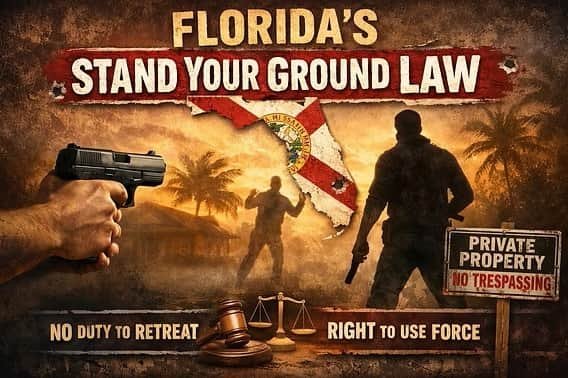
What Is Florida’s Stand Your Ground Law?
Florida’s Stand Your Ground doctrine is primarily addressed in Florida Statutes Section 776.012, which governs the use or threatened use of force in defense of a person. The law generally allows a person who is not engaged in unlawful activity and who is in a place where they have a right to be to use or threaten to use nondeadly or deadly force under specified circumstances, without first having a duty to retreat.
The central principle is that a person who satisfies the statutory conditions does not have to retreat before using legally justified force. Nevertheless, the absence of a duty to retreat does not mean that force is automatically justified whenever someone feels threatened.
The person’s belief about the need for force, the nature of the perceived danger, and the circumstances surrounding the encounter remain important. The law distinguishes between situations involving ordinary physical force and those in which deadly force may be legally justified.
When Is Nondeadly Force Justified?
Florida law allows the use or threatened use of nondeadly force when a person reasonably believes that such force is necessary to defend themselves or another person against another individual’s imminent use of unlawful force.
Nondeadly force generally refers to force that is not intended or likely to cause death or great bodily harm. Whether particular conduct qualifies depends on the circumstances and the nature of the force used.
For example, a person facing an imminent unlawful physical attack may be legally justified in using reasonable force to prevent the attack. However, using force to retaliate after a confrontation has ended is different from using force to prevent an immediate threat.
The law does not permit someone to escalate every verbal disagreement into physical violence. A reasonable belief in the need for defensive action and the existence of an imminent unlawful threat are central considerations.
When Is Deadly Force Legally Justified?
Deadly force is subject to stricter legal requirements. Under Florida Statutes Section 776.012, a person may use or threaten deadly force if they reasonably believe it is necessary to prevent imminent death or great bodily harm to themselves or another person, or to prevent the imminent commission of a forcible felony, subject to the statutory conditions.
The concept of reasonable belief is important. Courts and other decision-makers may examine the circumstances known to the person at the time, the nature of the perceived threat, and whether the belief in the need for deadly force was legally reasonable.
A person cannot rely on Stand Your Ground simply because another person was aggressive, insulting, or involved in a heated argument. The threat must meet the legal requirements for the particular type of force used.
Deadly force may also raise separate issues involving defense of a home, vehicle, or occupied structure. Florida’s related self-defense provisions address those circumstances, but their requirements differ from the general Stand Your Ground framework.
How the No-Duty-to-Retreat Rule Works
Before Florida adopted its current Stand Your Ground framework, traditional self-defense rules in some circumstances required a person to retreat if they could do so safely before using deadly force outside the home. Florida’s law removed that general duty to retreat for people who meet the statutory conditions.
Under Section 776.012, a person who is not engaged in unlawful activity and is in a place where they have a right to be generally has no duty to retreat before using or threatening to use force when the statutory requirements are satisfied.
This principle does not mean that a person should seek confrontation or that any response to a perceived threat is lawful. The use of force must still satisfy the applicable self-defense requirements. A person who initiates unlawful aggression or uses force for revenge may not be able to rely on the doctrine in the same way as someone responding to an imminent unlawful threat.
The facts of each encounter matter, and the law should not be interpreted as encouraging unnecessary violence.
Immunity From Criminal Prosecution and Civil Lawsuits
Florida Statutes Section 776.032 provides immunity from criminal prosecution and civil actions for people whose use or threatened use of force is legally justified under the applicable self-defense statutes. This protection can be significant because a defensive incident may otherwise lead to criminal charges or a lawsuit seeking compensation for injuries.
However, immunity is not automatic merely because a person claims self-defense. The legal requirements must be satisfied, and the facts must support the claim. Law enforcement may investigate the incident, and a court may need to determine whether immunity applies.
Florida law also establishes procedures for considering self-defense immunity before trial. Once a defendant raises a prima facie claim of immunity at a pretrial hearing, the party seeking to overcome that immunity must prove by clear and convincing evidence that immunity should not apply. The court evaluates the evidence under the statutory framework.
These procedures make it important to preserve relevant evidence and obtain legal representation when a serious incident occurs.
Situations Where Stand Your Ground May Not Apply
Florida’s self-defense protections have important limitations. A person who unlawfully provokes or initiates violence may be restricted from relying on the doctrine, subject to specific statutory exceptions. Section 776.041 addresses the use of force by an aggressor and sets out circumstances in which defensive force may become available again.
Likewise, force used for revenge, intimidation, or retaliation after an immediate threat has ended may not qualify as lawful self-defense. The doctrine does not authorize a person to escalate a disagreement simply because they believe they are entitled to stand their ground.
The legal analysis can also differ when an incident involves law enforcement officers performing official duties, unlawful activity, or conduct occurring in a location where the person has no legal right to be. The circumstances must be assessed individually.
Conclusion
Florida’s Stand Your Ground doctrine removes the general duty to retreat for people who meet the statutory conditions before using legally justified force. It also provides potential immunity from criminal prosecution and civil liability when the requirements for lawful self-defense are satisfied.
However, the law does not authorize retaliation or unlimited violence. The nature of the threat, the reasonableness of the person’s belief, the type of force used, and the surrounding circumstances all matter. Anyone involved in a serious self-defense incident should preserve relevant evidence and consult a qualified Florida criminal defense attorney.
Frequently Asked Questions
Q. Does Florida’s Stand Your Ground law require a person to retreat?
Generally, no. A person who meets the statutory conditions does not have a duty to retreat before using legally justified force. The force must still satisfy the applicable self-defense requirements.
Q. Can Stand Your Ground justify deadly force?
Deadly force may be justified when a person reasonably believes it is necessary to prevent imminent death or great bodily harm to themselves or another person, or to prevent the imminent commission of a forcible felony, subject to statutory conditions.
Q. Does Stand Your Ground automatically prevent an arrest?
No. Law enforcement may investigate a defensive incident. Florida law generally prohibits arresting a person for covered defensive force unless the agency determines there is probable cause that the force was unlawful.
Q. Can a person face a civil lawsuit after using force in self-defense?
Florida law provides immunity from certain civil actions when the use of force is legally justified under the relevant statutes. Whether immunity applies depends on the facts and legal requirements.
Q. Does Stand Your Ground apply only inside a home?
No. Florida’s Stand Your Ground framework can apply in other places where a person has a legal right to be, subject to the statutory requirements. Separate rules also govern defense of a home, residence, or occupied vehicle.