 By Olivia Wilson
Florida allows eligible individuals to carry concealed weapons or firearms without obtaining a state license, subject to statutory conditions. However, this permission does not extend to every public building, private business, or government facility. Certain locations remain legally restricted, even for individuals who otherwise qualify to carry a concealed firearm.
Understanding Florida’s prohibited-location rules is essential for residents, visitors, and firearm owners who want to avoid criminal penalties. The restrictions are primarily addressed in Florida Statutes Section 790.06(12), along with separate laws governing schools, federal facilities, and other locations.
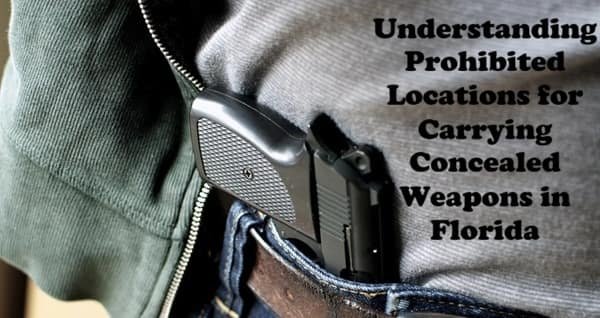
Government Buildings and Law Enforcement Facilities
Florida law generally prohibits carrying concealed weapons or firearms into police stations, sheriff’s offices, highway patrol stations, detention facilities, prisons, and jails. Courthouses and courtrooms are also included in the statutory restrictions, subject to specific exceptions.
These rules help maintain security in places where law enforcement activities, judicial proceedings, or the custody of individuals require additional safeguards. A concealed-carry license or eligibility under Florida’s permitless-carry framework does not automatically authorize firearm possession in these facilities.
Government meetings are also restricted in specified circumstances. Florida law prohibits concealed carry at meetings of the governing bodies of counties, municipalities, public school districts, and special districts, as well as meetings of the Florida Legislature or its committees.
Individuals attending court hearings, public meetings, or visiting law enforcement facilities should check the applicable rules before entering. Carrying a firearm into a prohibited area can result in criminal consequences.
Schools, Colleges, and Athletic Events
Florida places significant restrictions on firearms at educational facilities. Section 790.06 generally prohibits concealed weapons and firearms at elementary and secondary school facilities, administration buildings, and career centers. The law also restricts carrying at schools, colleges, and professional athletic events that are not related to firearms.
Separate provisions under Section 790.115 regulate firearm possession on school property, at school-sponsored events, on school buses, and at school bus stops. Limited exceptions exist, including certain circumstances involving firearms in vehicles, but these exceptions have specific conditions and may be affected by school district policies.
College and university facilities are subject to restrictions as well. The statute provides a narrow exception for certain nonlethal defensive devices carried by qualifying registered students, employees, or faculty members. This should not be confused with general permission to carry firearms on campus.
Parents, students, employees, and visitors should review the applicable rules before bringing a firearm onto educational property. The fact that a person can lawfully carry elsewhere in Florida does not establish that carrying is permitted on school or campus grounds.
Polling Places and Legislative Meetings
Florida law prohibits carrying concealed weapons or firearms at polling places. This restriction applies to locations where voting takes place, so firearm owners should make alternative arrangements before visiting a polling location.
The law also restricts firearms at meetings of the Florida Legislature and its committees, as well as meetings of specified local government bodies. These restrictions apply even when a meeting is open to the public.
People attending public hearings, legislative sessions, or local government meetings should confirm the venue’s rules and applicable legal requirements in advance. A public building is not automatically a place where concealed carry is lawful.
Restaurants and Establishments Serving Alcohol
Florida’s restrictions concerning alcohol-serving establishments are more specific than a blanket prohibition covering every restaurant or bar. Section 790.06 generally prohibits concealed carry in the portion of an establishment licensed to serve alcoholic beverages for consumption on the premises that is primarily devoted to that purpose.
This distinction matters because a restaurant that serves alcohol may contain dining areas that are not primarily devoted to alcohol consumption. However, the facts and layout of the establishment can affect how the restriction applies.
Firearm owners should not assume that a concealed weapon may be carried into a bar or similar area simply because they hold a license or qualify for permitless carry. When uncertain, checking the applicable law and avoiding restricted areas is a prudent approach.
Airports and Federal Facilities
Florida law restricts concealed weapons and firearms inside the passenger terminal and sterile area of an airport, subject to a limited exception for a legal firearm properly encased for shipment as checked baggage.
Federal law can impose additional restrictions in federal buildings and other federally controlled locations. Examples may include certain federal offices and facilities where firearms are prohibited by federal law.
Travelers should distinguish between transporting a firearm lawfully and carrying it on their person inside a restricted area. Airline baggage rules, airport security requirements, and applicable federal law may all affect the process. Before traveling, firearm owners should check current rules for the airport, airline, and destination.
Private Property and Religious Institutions
Private property owners may establish rules concerning firearms on their premises, subject to applicable law. A business or property owner may ask a person carrying a firearm to leave. Refusing a lawful direction to leave can create additional legal problems, depending on the circumstances.
Florida Statutes Section 790.06(13) also contains a provision allowing qualifying concealed-carry license holders to carry on property owned, rented, leased, borrowed, or lawfully used by a church, synagogue, or other religious institution for lawful purposes. However, the provision preserves the institution’s private property rights to control its premises. It should not be interpreted as an unconditional right to carry into every religious facility.
Conclusion
Florida’s concealed-carry laws contain important location-based restrictions that apply even to otherwise eligible firearm carriers. Government facilities, courthouses, polling places, educational properties, certain alcohol-serving areas, airport security areas, and federally restricted locations require particular attention.
Before entering a building or venue with a concealed weapon, individuals should verify the applicable rules rather than assuming that permitless carry authorizes possession everywhere. Reviewing the current statutes and seeking qualified legal advice when necessary can help prevent avoidable legal complications.
Frequently Asked Questions
Q. Can I carry a concealed firearm into a courthouse in Florida?
Generally, no. Florida law prohibits carrying concealed weapons or firearms into courthouses and courtrooms, subject to specific statutory exceptions.
Q. Are firearms prohibited at Florida polling places?
Yes. Florida law generally prohibits concealed weapons and firearms at polling places, including during voting.
Q. Can I carry a concealed firearm into a restaurant that serves alcohol?
The restriction generally applies to the portion of a licensed establishment primarily devoted to serving alcohol for consumption on the premises. The exact circumstances and layout may matter.
Q. Does permitless carry allow firearms on school property?
No general permission exists. School property is subject to strict restrictions, with limited statutory exceptions. Owners should review the applicable provisions before entering school grounds with a firearm.
Q. Are firearms prohibited in airport terminals?
Florida law restricts concealed weapons and firearms in passenger terminals and sterile areas, subject to a limited exception for firearms properly encased for checked baggage. Federal and airport security rules also apply.